Researchers have been building genetically encoded logic gates for years. A harder problem is connecting those gates in different ways without rebuilding the genetic circuitry from scratch. Hamid Doosthosseini, Haorong Chen and Christopher Voigt tackled that problem by placing engineered bacteria in different arrangements on a surface.
Their study, Living circuit boards built by printing bacterial transistors, was published in Nature Chemical Biology on 17 August 2026. The team used strains of Pantoea agglomerans to implement two transistor-like functions and three relay functions. By printing patterns of those five strains, they produced several logic arrangements.
Why arrangement changes the computation
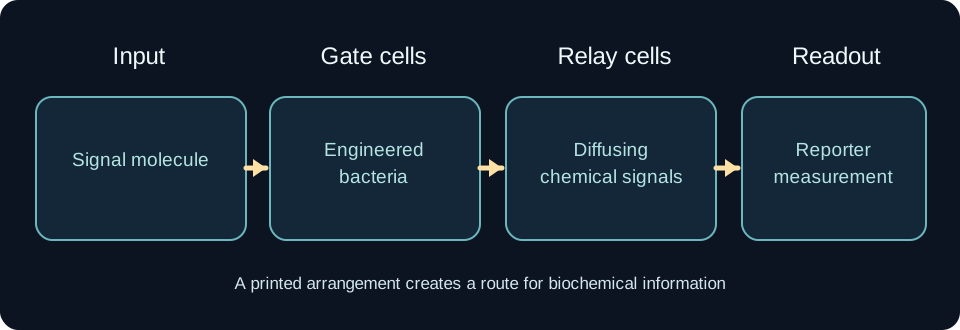
Inside a circuit, one engineered strain detects an input molecule and changes the molecules it releases or removes. Nearby strains receive the resulting chemical signals. Relay strains convert a diffusing signal into a directed transmission step. By choosing which engineered colonies sit near which others, researchers can connect logical operations spatially.
The useful idea is similar to a modular electronics laboratory: define a small set of reusable operations, then connect them differently. The difference is that bacteria communicate through molecular concentration fields, not electrical wires, and the geometric layout helps determine which signals meet.
What they built
The paper describes multi-input and multi-output logic, a one-to-four demultiplexer, a half-adder and a full-adder. A demultiplexer sends an input to one of several outputs according to a selector. A half-adder combines two binary inputs into sum and carry outputs. A full-adder also accounts for an incoming carry bit. Implementing these different operations from the same strain set demonstrates the modularity of the layout method.
The bacterial cells were deposited using an acoustic liquid handler. Their printed positions establish the routes for chemical signalling. The paper does not show a practical alternative to a microprocessor, nor does it establish that these circuits operate on the time scale of electronic gates.
What the study actually establishes
Peer-reviewed finding: predefined bacterial functions can be combined into several working logic designs by changing the spatial arrangement, without redesigning the five cell types for every circuit.
What remains: biochemical signal propagation takes time; individual cells and colonies vary; cross-talk and diffusion geometry can constrain more complicated designs. Scaling to larger, independently addressable circuits would require considerably more characterisation.
Where living logic might be useful
Chemical or environmental sensing is an attractive direction because the input is already biological or molecular. A living circuit could potentially integrate several environmental cues before producing a reportable response. Other possibilities include smart living materials or programmable biological manufacturing. These uses are plausible research aims; the August paper is a proof of architecture, not evidence that any specific product has reached deployment.
The result sits alongside September's generative mammalian-cell biocompiler. The bacterial work programmes connections between engineered strains, whereas the mammalian preprint searches for new regulatory circuits within cells. Together they illustrate why cellular computing deserves its own place in the biocomputing map.