Organoid intelligence (OI) is a research programme that uses three-dimensional brain organoids as biological information-processing systems. It brings together stem-cell biology, electrophysiology, machine interfaces and computational methods.
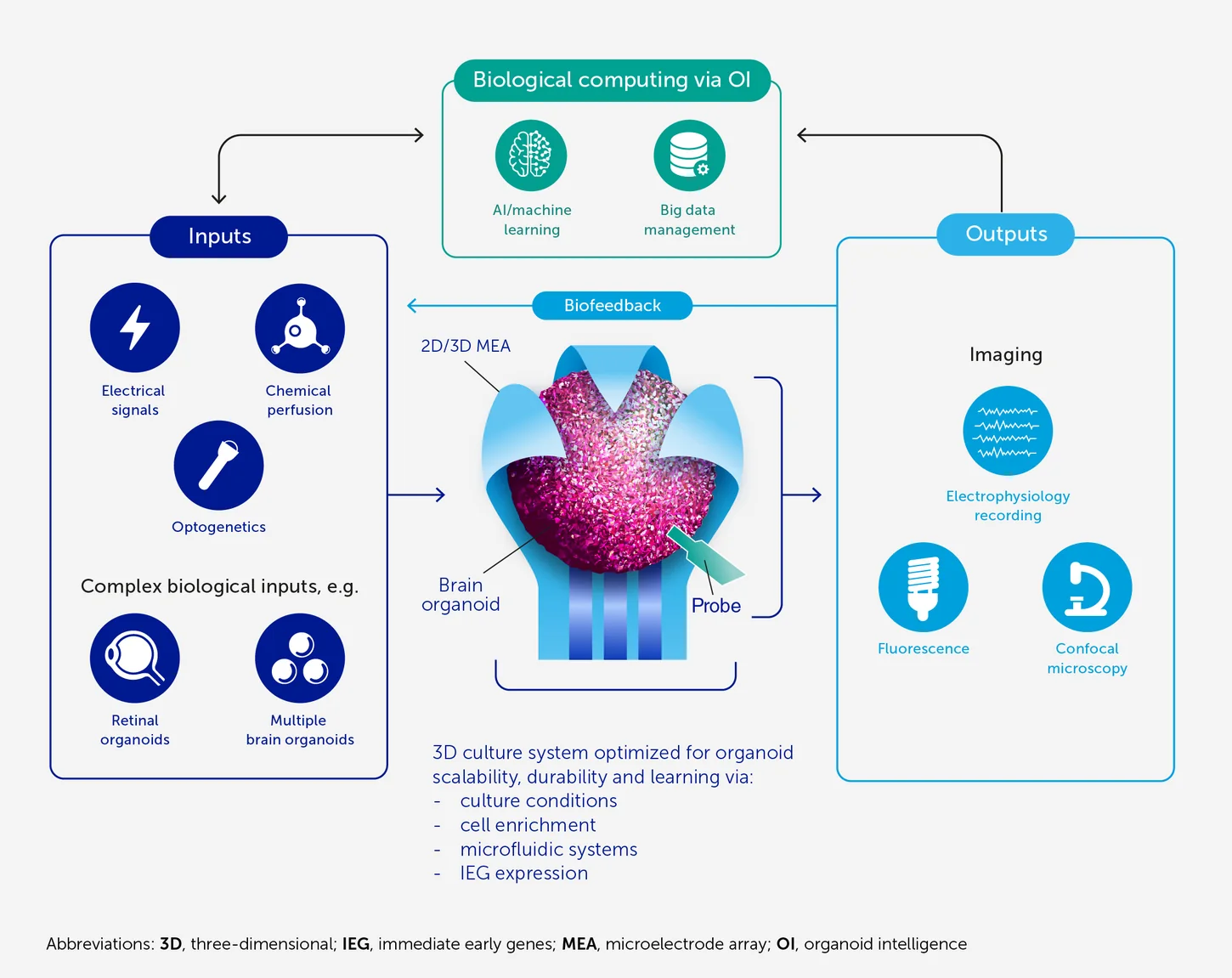
Brain organoids are not miniature adult brains. They are self-organising neural tissues that reproduce selected features of developing brain tissue. For computing experiments, their attraction is that they provide dense, living neural networks with plastic synapses and richer three-dimensional organisation than a dissociated monolayer.
What has actually been demonstrated?
Brainoware used a brain organoid as a physical reservoir for speech-recognition and nonlinear-prediction tasks. In 2026, Robbins and colleagues reported goal-directed adaptation in mouse cortical organoids performing a cart-pole task. The peer-reviewed Braille-classification study used electrically encoded tactile sensor data with human forebrain organoids and reported improved classification from a three-organoid ensemble.
A September 2026 Brainobot preprint extends that experimental line into physical robotics: an organoid reservoir-computing controller received sensory inputs and contributed to high-level decisions for object grasping and laser chasing on a humanoid robot. The paper is a preprint, so the result still awaits peer review.
The hard engineering problems
Three-dimensional tissue makes access difficult. Electrodes sample only part of the network, stimulation can be spatially coarse, tissue varies between preparations, and larger organoids develop transport problems for oxygen and nutrients. Useful computation also requires stable learning and reproducible readout over timescales longer than a single experiment. A 2026 Nature study also showed that human cortical organoids can be maintained and continue maturing over more than five years under suitable culture conditions, while five-year computing stability was outside the study.
What would count as progress?
Stronger benchmarks, independent replication, denser bidirectional interfaces, standardised organoid production and full-system energy measurements would all move the field forward. Progress should be judged against strong electronic systems performing the same task, using matched system-level metrics.