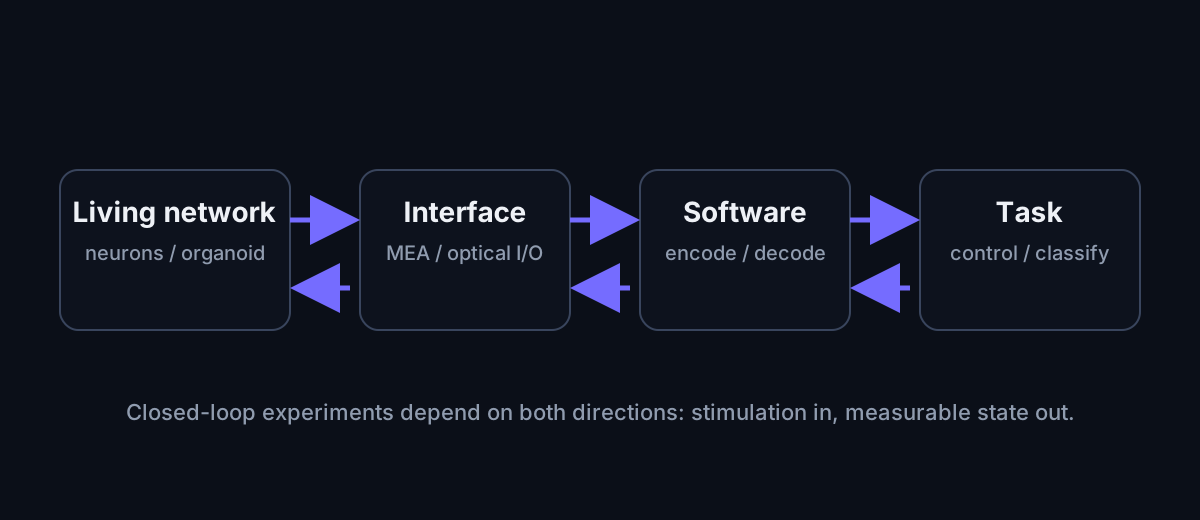
A biological neural network (BNN) is a network of living neurons whose electrical and chemical interactions produce collective dynamics. In biocomputing, the phrase usually refers to cultured neural networks that can be stimulated, recorded and coupled to a digital task.
The abbreviation can be confusing because “biological neural network” is also used more broadly for nervous systems in animals. On this site, BNN normally means an experimentally accessible in-vitro network unless the context says otherwise.
What makes the network computational?
The useful properties are nonlinear dynamics, recurrent connectivity and plasticity. A task can exploit spontaneous network dynamics as a reservoir, train a digital readout around them, or use structured feedback to alter the biological network itself.
Why culture structure matters
Connectivity in a flat dissociated culture can be highly variable and globally synchronized. The 2026 PNAS temporal-pattern study used microfluidic structures to create modular connectivity and reported that this organisation improved the dynamics needed for training. Three-dimensional cultures offer different connectivity again, along with harder I/O problems.
What BNNs are currently good at
Published demonstrations include game-like closed-loop control, reservoir classification, nonlinear prediction and generation of temporal patterns. These experiments establish useful computational behaviours while leaving scalability, reproducibility and whole-system advantage unresolved.