How electrodes, microfluidics and three-dimensional electronics move information into and out of living neural networks.
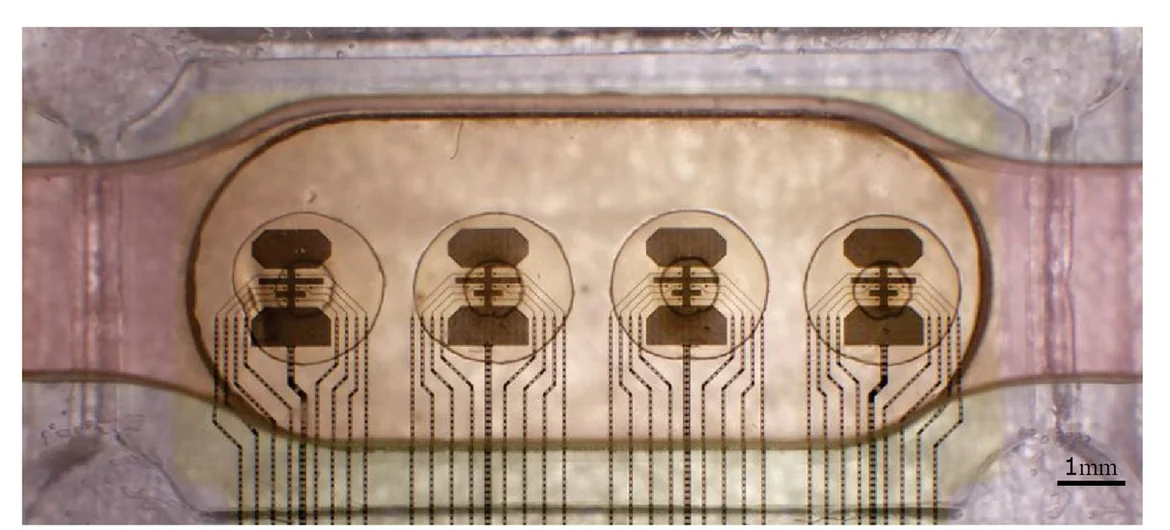
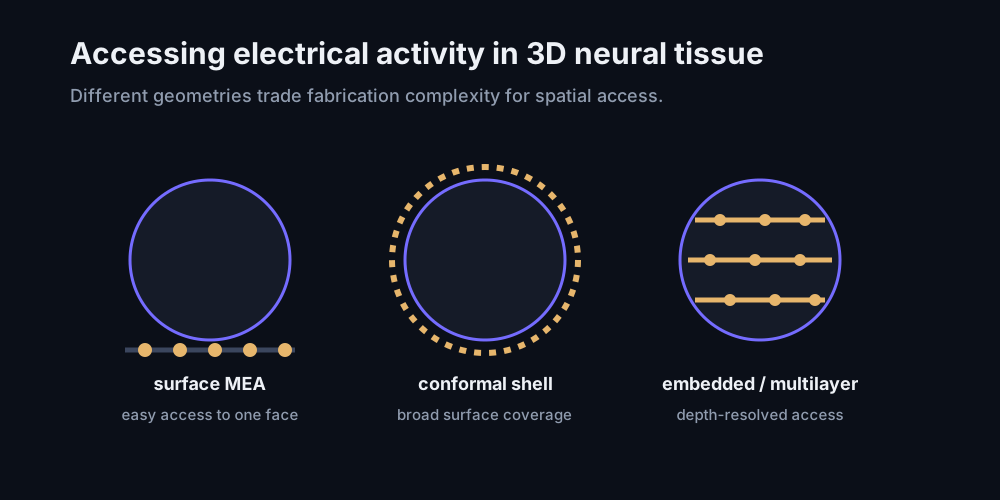
A real four-site MEA from the FinalSpark Neuroplatform. The interface places electrode groups beneath maintained forebrain organoids.Jordan et al. 2024, Figure 1E crop · CC BY 4.0·asset recordSurface, conformal and depth-resolved geometries provide different access to three-dimensional neural tissue.Biocomputers original schematic·asset record
The interface is one of the central engineering bottlenecks in living-neural computing. A network may contain thousands or millions of active cells while the experiment can stimulate or record only a small, spatially biased subset. Increasing useful bidirectional access changes what can be trained, measured and reproduced.
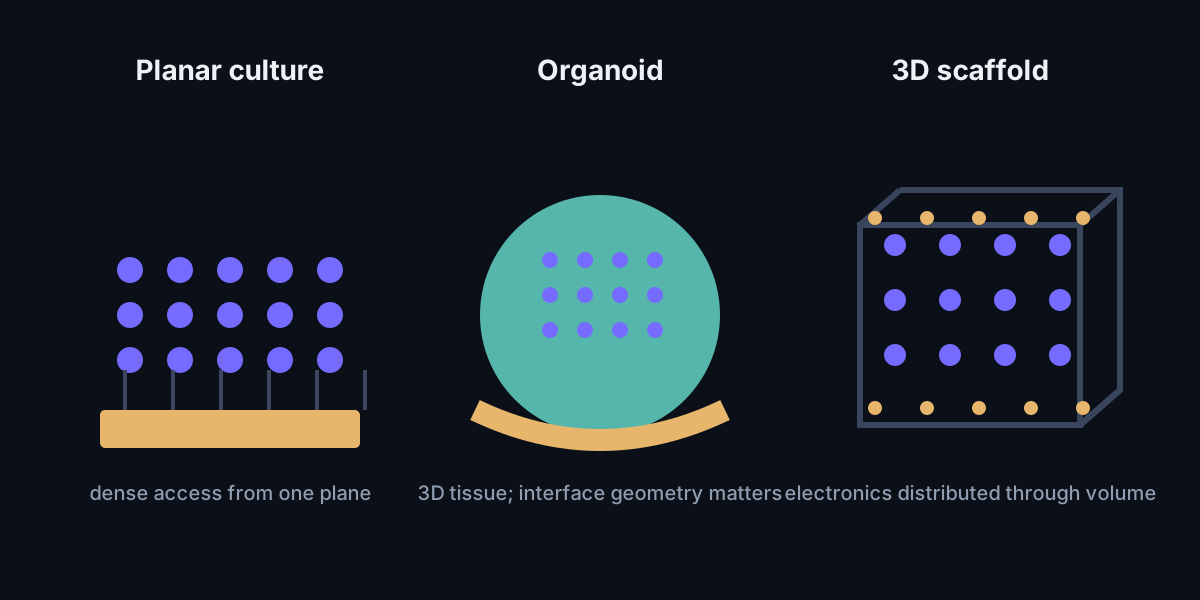
Three common geometries create different access problems for electrodes and other interfaces.Biocomputers original schematic·asset record
Why 3D changes the problem
A planar MEA can provide dense access to a monolayer. Three-dimensional tissue places much of the network away from that plane. Current approaches include embedded flexible electronics, multilayer meshes and shape-conformal structures that wrap around an organoid.
2026 interface progress
3D-MIND integrated a flexible electronic sensor and stimulator array through a cultured 3D neural network and reported recordings over six months. Liu and colleagues reported a shape-conformal framework covering up to 91% of an organoid surface with 240 independently addressable electrodes. Kim and colleagues reported a multilayer mesh MEA that recorded depth-dependent activity for more than four weeks.
Channel count is only one variable
Useful I/O also depends on spatial distribution, stimulation selectivity, signal quality, chronic stability, tissue health and how many channels remain informative during an actual closed-loop task. A large nominal electrode count can therefore be a poor proxy for computational bandwidth.