Cortical Labs has publicly demonstrated a CL1 living-neuron system interacting with Doom. The company hosts the demonstration and describes Doom running on a CL1 through Cortical Cloud. That supports the existence of a real closed-loop demo. The site's peer-reviewed evidence tier currently contains no paper reporting the Doom experiment.
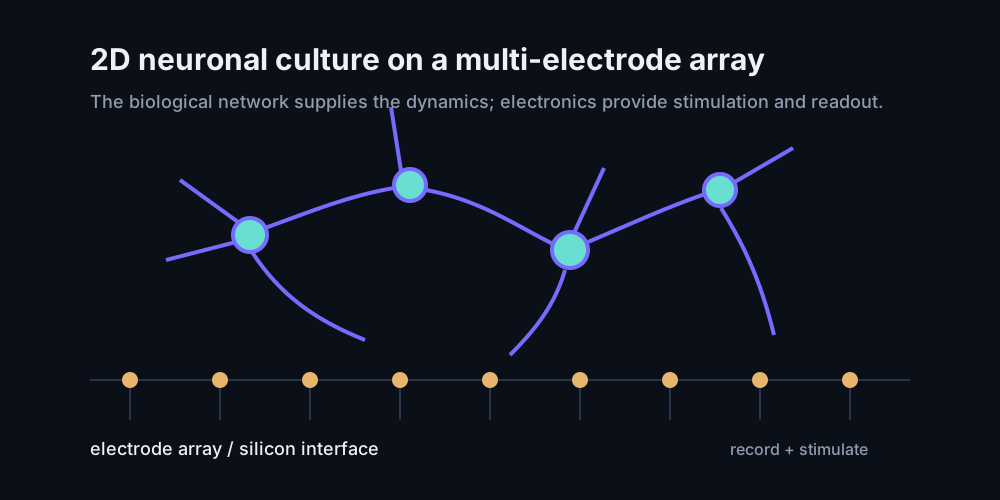
What “playing Doom” means here
The neurons are part of a hybrid control loop. Conventional software runs the game, encodes selected game variables as electrical stimulation and decodes neural responses into actions. The biological culture contributes to the controller. The Doom engine remains conventional software.
What would strengthen the evidence
A publishable benchmark would specify the encoding and decoding rules, controls, learning criterion, repeated cultures, variance, ablations and a baseline controller. Those details would let outside groups distinguish learned adaptation from task-specific signal coupling and quantify the biological contribution.
Why the demo is still useful
Doom is more complicated than the simplified Pong environment used in DishBrain and it provides a visible test bed for richer closed-loop interaction. As a demonstration it shows what the CL1 software/hardware stack can connect to. Scientific claims about learning should be graded separately from the existence of the demo.