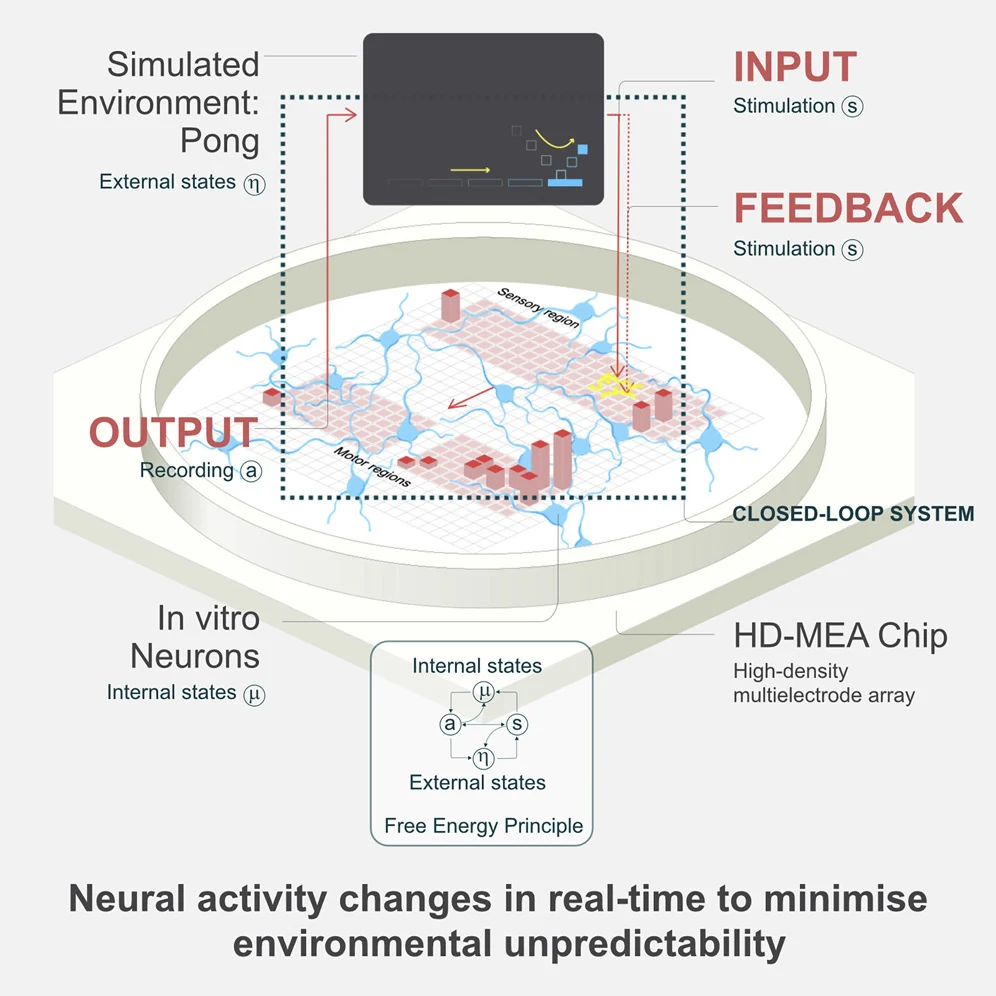
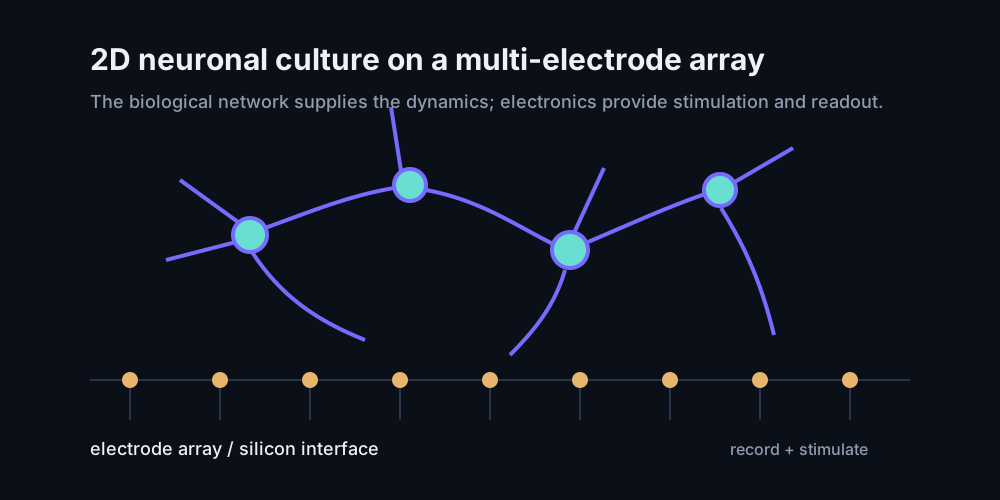
Yes, with an important qualification: the 2022 DishBrain study reported task-dependent improvement when cultured cortical neurons were embodied in a simplified Pong environment through a high-density multi-electrode array. The biological network received structured electrical information about the game and its activity influenced paddle movement.
What changed during the experiment
The study compared neural cultures exposed to closed-loop gameplay with controls. The reported performance measures improved over the training period under the structured feedback condition. The experiment therefore provides evidence that network activity adapted in a task-relevant way.
How to interpret “learned Pong”
Software encoded game state into stimulation patterns and decoded neural activity into paddle movement. The culture therefore interacted with a reduced experimental representation of Pong; the digital game logic remained in conventional software.
The paper used the term “sentience” in a specific theoretical context. That wording remains controversial and should not be treated as evidence for conscious experience.
Why the experiment matters
DishBrain established a reproducible architecture for bidirectional interaction between living cortical networks and a software environment. Later systems have explored organoids, reservoir computing, remote access and different training protocols.